
VA Loan vs. FHA vs. Conventional: How the Three Compare for Metro Atlanta Buyers


How the Three Loans Compare on Down Payment, Mortgage Insurance, Seller Help, and the Home Itself
A veteran buying a home in metro Atlanta can choose from three common loan types: a VA loan, an FHA loan, and a conventional loan. Each one has its own rules for the down payment, for mortgage insurance, for how much a seller can contribute, and for the condition of the home. This post compares those four areas using the published guidelines from the VA, the Federal Housing Administration, and Fannie Mae, so a buyer can see how the loans differ before sitting down with a lender.
A VA loan is a mortgage guaranteed by the U.S. Department of Veterans Affairs for eligible veterans, service members, and certain surviving spouses. An FHA loan is insured by the Federal Housing Administration, which is part of the U.S. Department of Housing and Urban Development, or HUD. A conventional loan is a mortgage that is not part of a government loan program, and many conventional loans follow guidelines set by Fannie Mae, which helps support the housing finance market. One difference comes before any of the rules below: a VA loan is open to those with qualifying service, while FHA and conventional loans are open to any qualified buyer.
The Down Payment
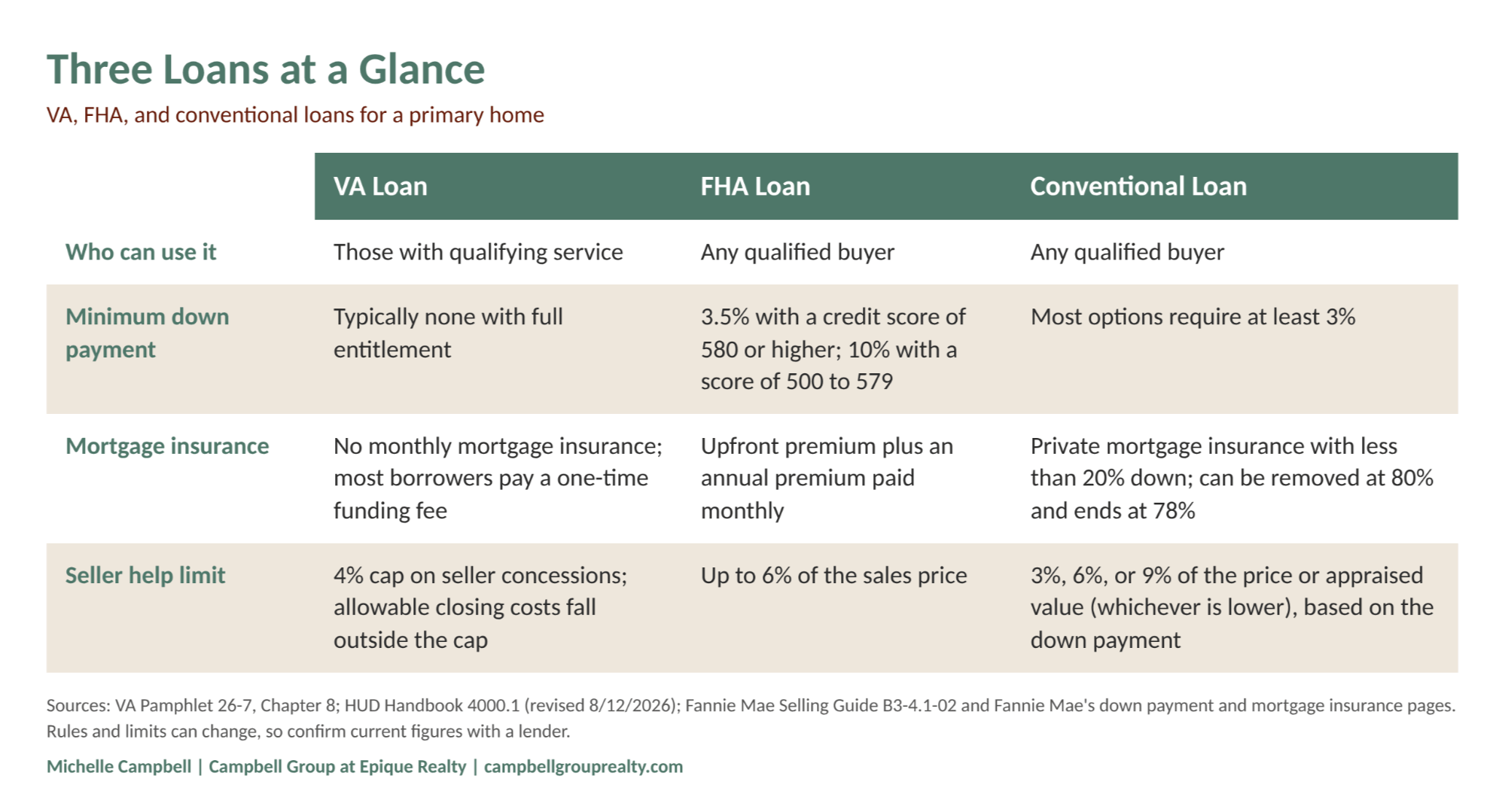
The VA loan typically requires no down payment when the veteran has full entitlement, meaning the full VA home loan benefit is available for the purchase. A veteran can still choose to put money down, and a down payment of 5 percent or more lowers the VA funding fee, a one-time fee paid to the VA that is discussed below.
The FHA loan requires a minimum investment of at least 3.5 percent of the home's value. HUD ties that 3.5 percent minimum to the buyer's credit score. A buyer with a score of 580 or higher can put down 3.5 percent, and a buyer with a score from 500 to 579 needs at least 10 percent down. A lender can tell a buyer which of those two applies.
Fannie Mae says most of its loan options require at least 3 percent down. That makes 3 percent the lowest down payment a conventional buyer can generally expect. Fannie Mae points to two programs built around that 3 percent minimum. The first is HomeReady, which is open to buyers whose income falls within set limits. The second is a 97 percent loan option for first-time buyers who qualify, which means the loan covers up to 97 percent of the home's value and the buyer brings the other 3 percent as a down payment. A lender can tell a buyer whether either program applies to their situation.
Mortgage Insurance and the Funding Fee
Mortgage insurance protects the lender if a buyer stops making payments. The three loans handle that protection in three different ways.
The VA loan has no monthly mortgage insurance. Most VA borrowers instead pay a one-time VA funding fee, which can be added to the loan amount, and veterans in certain categories owe nothing at all. My post on the funding fee explains what the VA funding fee costs and which veterans owe nothing.
The FHA loan has two kinds of mortgage insurance premium. The first is a one-time upfront premium, which can be financed into the loan. The second is an annual premium that is paid in monthly installments. The rate and the length of time depend on the loan amount, the loan term, and the down payment, and under HUD's published schedule a smaller down payment can mean the annual premium lasts for the full term of the loan. A lender can confirm the current rate and duration for a specific loan.
A conventional loan with less than 20 percent down usually carries private mortgage insurance, called PMI, which is paid monthly and protects only the lender. A buyer can ask to have PMI removed once the loan balance reaches 80 percent of the home's original value, and it can end automatically at 78 percent.
Seller Help With Costs
Sellers sometimes agree to pay part of a buyer's costs, and each loan sets its own limits on how much.
On a VA loan, seller help falls into two groups. The first is the veteran's allowable closing costs, which are the charges the VA permits a buyer to pay, such as the appraisal, credit report, recording fees, and title charges. A seller can pay these for the buyer, with no VA limit. The second is a seller concession, which is an extra the seller is not normally expected to provide, such as paying the buyer's funding fee or funding a temporary interest rate buydown, which lowers the rate for the first part of the loan. The VA caps seller concessions at 4 percent of the appraised value of the home. My post on seller concessions covers how VA separates closing costs from seller concessions.
On an FHA loan, the seller and other interested parties, such as a builder, can contribute up to 6 percent of the sales price. That amount can go toward the buyer's closing costs, prepaid items, discount points, which are fees paid to lower the interest rate, interest rate buydowns, and the upfront mortgage insurance premium.
On a conventional loan for a primary home, Fannie Mae sets the limit by the size of the down payment, measured against the lower of the sales price or the appraised value, which is the value a licensed appraiser sets for the home. The limit is 3 percent when the buyer puts down less than 10 percent, 6 percent when the down payment is at least 10 percent but less than 25 percent, and 9 percent when the down payment is 25 percent or more.
The three loan types' limits are built differently, so the percentages are not a direct match. The VA's 4 percent covers a defined group of extras and leaves allowable closing costs outside the limit, while the FHA and conventional percentages count help with closing costs toward the limit.

The Home Itself
All three loans begin with an appraisal, which is a licensed appraiser's opinion of the home's value. The VA and FHA also publish property standards that a home must meet. The VA's minimum property requirements address safety, structural, and health concerns. HUD's minimum property requirements address the safety, soundness, and security of the home. Both VA and FHA appraisers note any repairs needed to meet their minimum property requirements.
On either loan, the appraisal covers the home's value and its condition against the property standards, and it does not take the place of a home inspection. The VA states that its appraiser does not test mechanical systems or appliances, and the Notice of Value, the document that reports the home's value to the veteran, includes a recommendation that the veteran consider a home inspection. HUD requires FHA lenders to give buyers a notice titled For Your Protection: Get a Home Inspection. A home inspection is worth planning for with any of the three loans.
If the appraised value comes in lower than expected, all three loans have a formal way to ask for another look after the appraisal report is done. It is called a reconsideration of value, which is a request that the appraiser review the value. On an FHA or conventional loan, the buyer can ask the lender for one reconsideration of value per appraisal, and the lender sends the request and the buyer's supporting information to the appraiser. On an FHA loan, that information can include up to five alternative comparable sales, which are recent sales of similar homes nearby, and the buyer cannot be charged for the review. A VA buyer can request a reconsideration of value too.
The VA adds a step before the report is final that the FHA and conventional guidelines do not include. Under the VA's Tidewater process, an appraiser who sees the value likely falling below the sales price must notify the lender before finishing the appraisal, then allow two business days for the parties to send in additional sales data. The appraiser does not discuss the expected value during this step. It gives the parties a chance to help support the value before the report is final.
Choosing Among the Three
Each loan has its own strengths. The VA loan typically requires no down payment and has no monthly mortgage insurance, although most borrowers pay the funding fee. The FHA loan is open to buyers without military service, with a minimum down payment of 3.5 percent for those with a credit score of 580 or higher, and mortgage insurance premiums that can last for the life of the loan. The conventional loan can drop its mortgage insurance once enough of the loan is paid down, and for qualifying buyers the minimum down payment is 3 percent. A veteran can compare all three before choosing, and running the numbers with a lender before touring homes shows what each one means for the cash needed at closing and the monthly payment. If you plan to finance, I can point you to a lender who can show you rate options for your situation.
If you are a veteran starting a home search in north metro Atlanta and would like to talk through how each of these loans shapes an offer, I am glad to help.
Michelle Campbell | Campbell Group at Epique Realty | campbellgrouprealty.com
Categories
Recent Posts