

Why Some Sellers Hesitate on VA Offers, and How to Make Yours Stronger


A Metro Atlanta REALTOR® on the Questions Sellers Raise About VA Financing and the Answers a Buyer Can Give
A seller is free to accept any offer, and the market has tilted toward buyers. Redfin reported in November 2025 that VA loans were becoming more common as buyers gained leverage and sellers grew more willing to accept offers with low down payments. However, Redfin noted that some sellers still favor offers with bigger down payments. A seller who hesitates over a VA offer usually has a few specific questions in mind, and a buyer and an agent can answer them in advance.
The concerns tend to be the same few: whether the home will appraise at the contract price, whether the appraisal will call for repairs, how long the sale will take, and whether a buyer with no down payment can close. The VA's own guide for real estate professionals lists several of these as common myths. The sections below take them in order.
The Appraisal Question
Every VA purchase loan requires an appraisal, which is a licensed appraiser's opinion of what the home is worth. The appraiser also checks the home against the VA's minimum property requirements, the safety, structural, and health standards a home must meet before the VA will guarantee the loan. The results arrive in a Notice of Value (NOV), the VA's document listing the estimated value, comparable sales, and any repairs required.
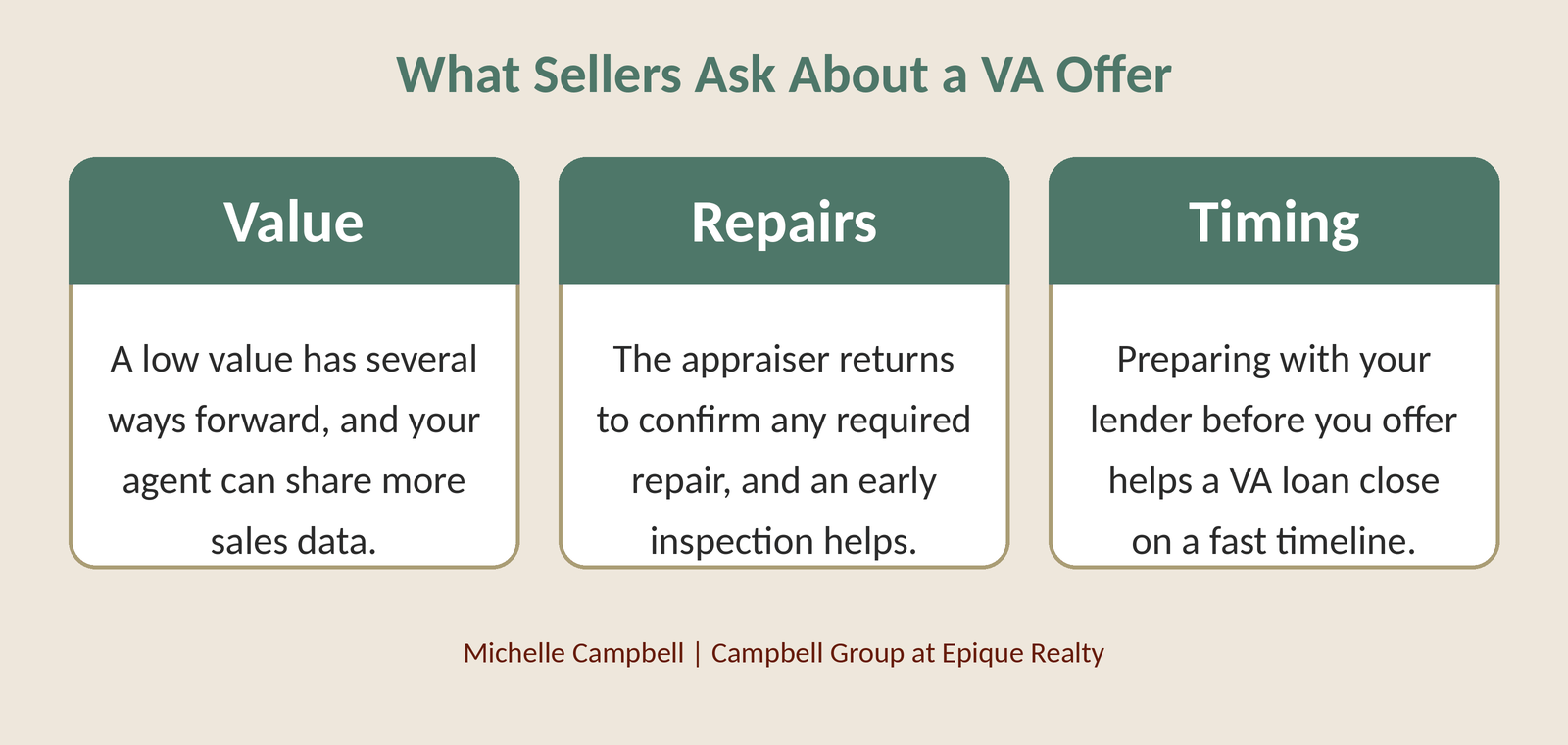
The VA has several ways to respond when a value looks low. Before finishing a report that is likely to come in below the price, the appraiser notifies whoever ordered the appraisal and allows two business days for additional sales data. This is the Tidewater process, and a related post explains what happens during the Tidewater window in full. If the final value is still short, the buyer can ask for a reconsideration of value, in which VA staff review the report and any new sales data. The buyer can also renegotiate the price, pay the difference in cash at closing, or use the escape clause, a required part of every VA purchase contract that lets the buyer walk away without forfeiting the earnest money deposit, the deposit a buyer puts down to show commitment, when the price is above the value the VA sets.
That last option is part of why a seller weighs the price risk, and it is also a protection that belongs to the buyer. For context, the VA reports that 90 percent of initial VA purchase appraisals met or exceeded the contract price in fiscal year 2023. Price is only one of the risks, though. Because appraisals are a normal part of most financed purchases again, what a seller tends to notice with a VA loan is the repair risk, since the property check can add repair work to the sale.
The Repair Question
When the NOV lists a repair, the appraiser returns for a repair inspection to confirm the work. I lay out the three ways a required repair can be resolved in another post.
The requirements themselves changed in 2026. The VA's updates, effective May 1, 2026, removed the radon gas requirement and revised its standards for homes built before 1978 and for homes built in 1978 or later, among other changes. I cover what the 2026 VA appraisal updates changed in a separate post.
An appraisal is not a home inspection, and the VA strongly recommends that buyers complete an inspection. Scheduling it early helps a buyer's agent see items an appraiser may also note, so the repair conversation with the seller can happen while the inspection results are fresh and before the appraisal report arrives.
The Timeline Question
Some sellers expect a VA sale to take longer. The VA's guide for real estate professionals reports 2023 averages of 32 days to close for VA loans, 45 days for conventional loans, and 46 days for FHA loans, based on data from ICE Mortgage Technology. More recently, ICE reported that the average purchase loan closed in 36.8 days in March 2026, the fastest pace since ICE began tracking in 2019. That figure is for purchase loans overall, not VA loans alone. On appraisals, the VA reported on June 25, 2026, that the average appraisal took about seven business days as of May 31, 2026.
Those are national figures, and an average blends every loan, including the ones that hit delays. For a local view, Troy McNeely of Kind Lending, a lender I work with often on VA loans, tells me a well-prepared VA loan in the Atlanta area can close in as little as 21 days. By well-prepared he means the buyer has been through the process before making an offer, with records and funds verified. He says a comfortable pace for any loan type is 25 to 30 days, and he has closed a loan in as few as 18 days when everyone hustled. Going that fast means the buyer answers document requests right away and the appraisal is ordered early. A short due diligence window, the number of days a buyer has to inspect the home and decide whether to move forward, is a necessary part of a fast closing too. Any loan pushed for speed asks the same of everyone, so a VA loan can close on the same kind of fast timeline as any other.
The VA also sets how many business days an appraiser has, by county. The count starts the first business day after the assignment and skips weekends and federal holidays. No single number predicts a particular closing, so ask your lender how soon the appraisal will be ordered after the contract is signed. The VA's Buyer's Guide says the same: lenders should request the appraisal early in the loan process.

Showing Financial Strength
Some sellers read a zero-down loan as a sign that a buyer lacks cash. Cash is not the only sign of a strong buyer. The VA's guide reports that the average credit score of veteran purchase loan borrowers in fiscal year 2023 was 721. Before you make an offer, ask your lender to verify your records and funds, as described above, and to go over what your payments will look like after closing. A preapproval letter, a written statement from a lender of what you are approved to borrow, is submitted with your offer. On the offers I write, my lender also calls the listing agent. He discusses the preapproval, explains that the buyer is qualified, and answers the listing agent's questions about the financing, sharing only what he is permitted to share. Ask whether your lender will do the same.
A larger earnest money deposit is another way to show you are serious. If the VA value comes in below the contract price, the escape clause described earlier protects your deposit. Your agent can explain when a deposit is refundable and when it is not before you decide on an amount that fits your situation.
Making the Offer Easy to Accept
When I write an offer for a buyer, I start by finding out what matters most to the seller, such as the bottom line, the timeline, or how repairs are handled. A request for seller assistance with closing costs is something a seller weighs against what they net from the sale, so decide with your agent whether you need to ask. For the details, the VA rules on how much seller help is allowed have a post of their own.
A VA offer stands out through clear terms, prompt answers, and a lender who is easy to reach.
If you are a veteran starting a home search in north metro Atlanta, I can point you to a lender who handles VA loans and help you put together an offer that answers a seller's questions up front.
I am here when you are ready. I hope when the time comes, you will give me the chance to earn your trust.
Michelle Campbell | Campbell Group at Epique Realty | campbellgrouprealty.com
Categories
Recent Posts